Neuroinclusive Design Study
[The text below has been approved by Ethics committee]
See Science Differently?
How do different students make sense of diagrams?
Diagrams are used everywhere in science and health education, but not everyone processes visual information in the same way.
Our research is exploring how students engage with biomedical diagrams and how visual design may influence attention, understanding, and learning across different learners.
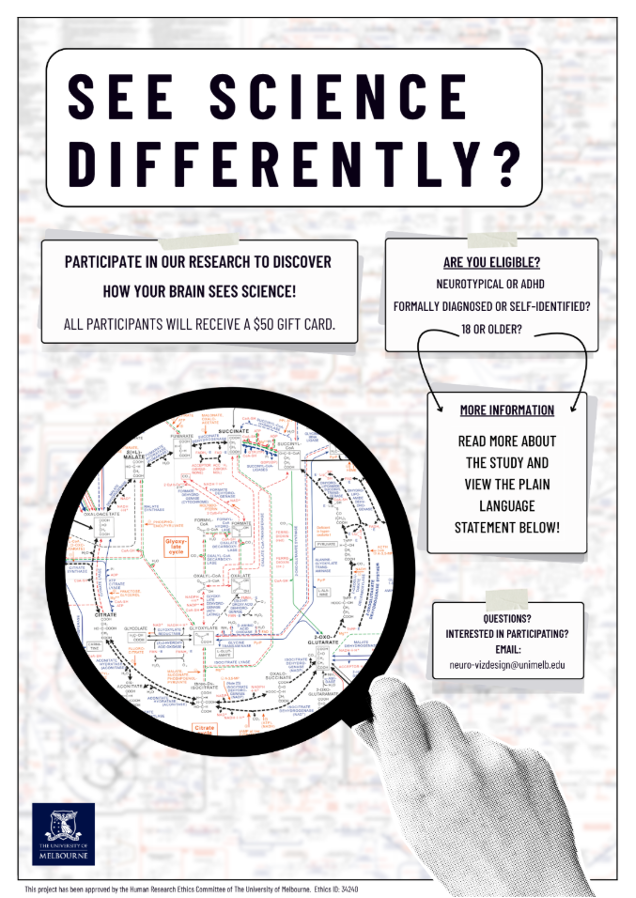
What is this research about?
This study is investigating how students visually navigate and understand biomedical diagrams.
We are interested in differences in how people attend to visual information and how diagram design may influence the way information is processed.
The broader aim of this research is to contribute to the development of clearer and more inclusive visual learning materials for biomedical education.
What would participation involve?
Participation will involve attending an in-person research session at the University of Melbourne of up to 90 minutes.
During the session, you will complete a series of activities involving biomedical diagrams. These include:
- Completing brief demographic questionnaire
- Viewing biomedical diagrams while your eye movements are recorded using eye-tracking technology
- Answering questions about the information presented
- Discussing your experience of interpreting the diagrams in a short interview with the researcher
Participants will receive a $50 gift card for their time involved in taking part in this study!
Further information about the study procedures, potential risks, privacy, confidentiality, and your rights as a participant is available in the Plain Language Statement below.
Download Plain Language Statement
Who are we looking for?
We are currently seeking University of Melbourne students aged 18 years or older.
The study is interested in hearing from students with different attentional and learning experiences, including:
- Neurotypical students
- Students who have been clinically diagnosed with ADHD
- Students who self-identify as having ADHD
To help ensure that the study groups can be interpreted clearly, participants must not have any known co-occurring neurodivergent conditions, whether clinically diagnosed or self-identified, such as autism, dyslexia, or dyspraxia.
If you are unsure whether you meet the eligibility criteria, you are still welcome to contact the research team, and we can provide further clarification.
Further information will be provided by the research team after you express interest.
Expressing interest does not commit you to participating in the study.
Interested in participating?
If you would like to learn more about the study or express your interest in participating, please contact:
neuro-vizdesign@unimelb.edu.au
You can simply email us to let us know that you are interested. The research team will then provide further information about eligibility and the next steps.
Participation is entirely voluntary.
This project has been approved by the Human Research Ethics Committee of The University of Melbourne. Ethics ID: 34240