Wishing all our School of Biomedical Sciences mums a Happy Mother’s Day!
From proud moments to laughter and tears, we acknowledge the power of mothers, grandmothers, maternal bonds and special caregivers.
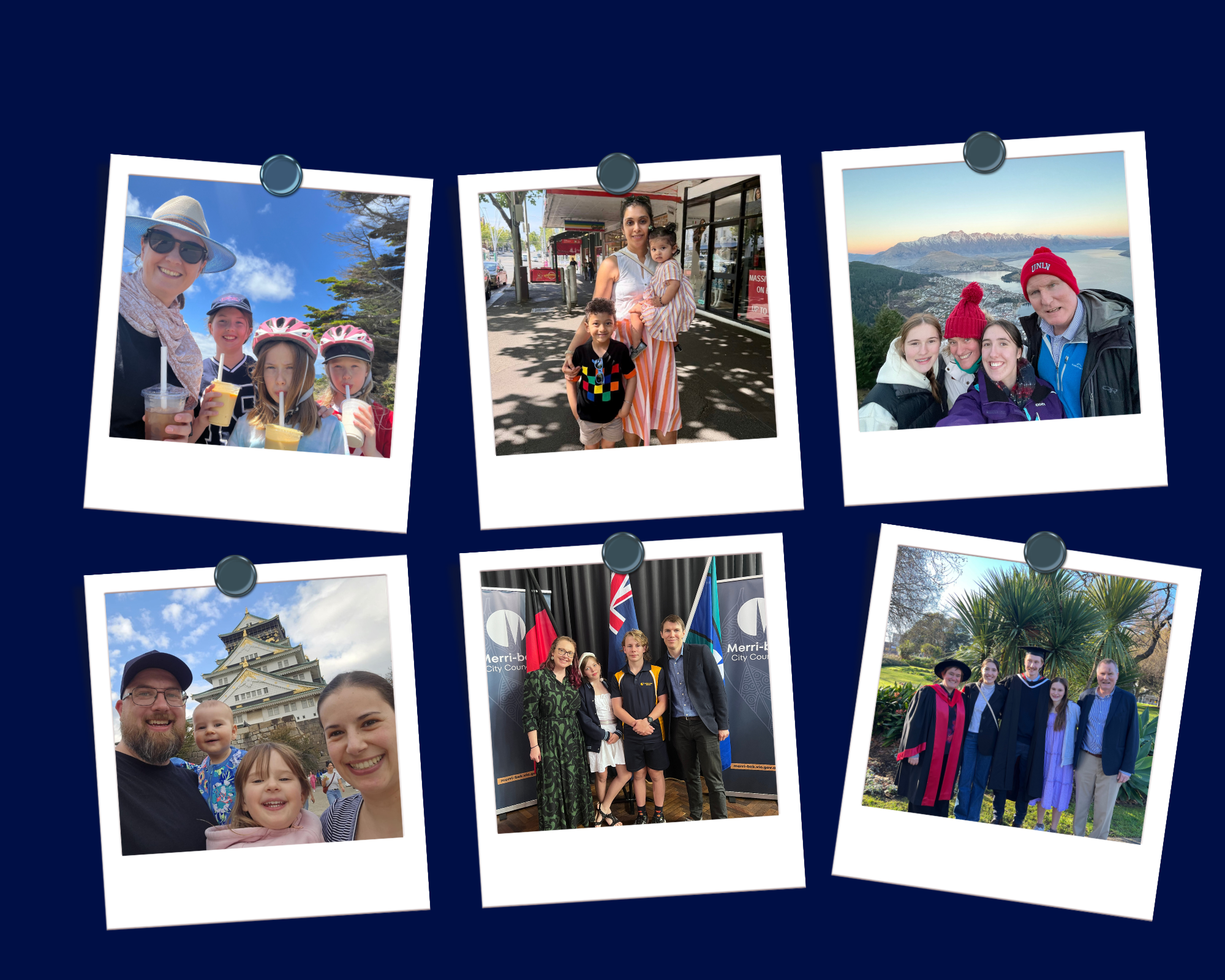
Ahead of Mother’s Day this Sunday, we checked in with parents across the School of Biomedical Sciences and asked them to share what they love about being a mum.
Associate Professor Robyn Brown, Department of Biochemistry and Pharmacology
“I am grateful my kids – 11-year-old Georgia and 9-year-old twins Alex and Evie – are happy and healthy and are at an age where they don’t need their bums wiped, do sleep through the night, yet still want to hang out with me.
Nothing prepares you for how hard parenthood is. And you think it’s going to get easier as they get older, but it stays hard but is just hard in a different way. When my kids were younger someone told me ‘the bigger the kids, the bigger the problems’ and this could not be more true.
The most joyous things are the cuddles and smiles and hilarious conversations. And when they still run and jump into your arms at school pickup. Kids force you to be present in a way that is super healthy for work-obsessed academics.”
Robyn is a DECRA Fellow and laboratory head who has investigated neuroplasticity in drug addiction, including parallels between drug addiction and overeating. Her team uses a multi-disciplinary approach including behavioural models, electrophysiology, fibre photometry, chemogenetics, optogenetics, transgenic mouse models, viral methods and confocal microscopy.
Dr Sapna Devi, Department of Microbiology and Immunology
“I have two children, my older one is almost 5 years old and my younger is 18 months.
Motherhood has changed my perspective … It’s helped me develop patience, perspective, and a stronger sense of purpose. There’s always a sense of hullabaloo and activity at home, it’s busier and more dynamic, but also really full of life.
I’ll spend Mother’s Day like any other Sunday, but with a meaningful afternoon surrounded by my family – especially my children’s grandmothers, whose support has been incredibly important to us.”
Sapna is an expert in using intravital multiphoton microscopy to image different organs such as the kidney, bone marrow, lung, muscle and lymph node. Her research examines the mechanisms of lymphocyte migration in tissues, including studying the effects of neurotransmitters.
Professor Erica Fletcher, Department of Anatomy and Physiology
“I have three children – aged 23, 21, and 14. Yes, we like to keep things interesting with a large age gap.
The most challenging thing for me has been the constant juggle of fitting all the kids activities, their friends and school things with work commitments. I have been unbelievably lucky that my husband is so supportive … I call him the Minister of Sport, while I’m the Minister of Culture!
The most joyous thing is watching the kids develop into wonderful human beings. My older two are like friends now, where we can discuss any topic – world events, politics, science. I can enjoy going to a concert or movie with them, feel a sense of pride in their views of the world and their contributions. For my youngest, I love being able to just 'hang out' with her."
I think I’ve become far more patient, and far more supportive of others, especially my students. I have learned not to sweat the small stuff, but to focus on the big picture.
Erica is an esteemed ophthalmologist and researcher whose work contributes to the development of better treatments for retinal disease. She leads a team of 14 students and postdoctoral fellows as Head of the Fletcher laboratory: Visual Neuroscience and has successfully supervised 17 PhD students through to completion.
Dr Jessica Neil, Department of Microbiology and Immunology
“This Mother’s Day I am grateful for the strength and love of generations of women in family, my grandmothers, mother and daughter, who have all made me into the woman that I am today.
I hope to spend Mother’s Day this year by sleeping in and getting cuddles from my kids, who are 2 and 5 years old.
One of the most challenging aspects of being a mother and an academic is balancing work with being present for my kids. After becoming a parent, I was surprised by how quickly my priorities shifted. Even though my career is important to me, some things that once felt urgent or important just didn’t seem so much of an issue.
The most joyous part is being able to see my kids grow, learn and develop their own interests and personalities.”
Jessica studies virus-host interactions with a focus on intestinal (rotavirus, norovirus) and respiratory (SARS-CoV-2) viruses. Currently, she is working in the laboratory of Professor Kanta Subbarao in the Department of Microbiology and Immunology investigating SARS-CoV-2 infection and antiviral therapies in cell and animal models.
Dr Charlotte Clark, School of Biomedical Sciences
“I love spending time with my children (son Elliott is 14 and in Grade 9, my daughter Juliet is 11 and in grade 6) but I am also grateful for the 'breathing space' that comes as they grow up and become more independent. I also enjoy having deeper conversations with my children. As they mature and this becomes more feasible, I feel grateful.
It surprises me, that even though it’s a long time since I was 11 or 14 years old, my children encounter many of the same sorts of day-to-day challenges as I did when I was that age! This also reassures me that my children are getting a similar childhood experience to me (and that perhaps social media and YouTube and AI have not ruined their childhood … yet)."
As a passionate educator, I get a lot of joy in watching my children learn. Sometimes, I suspect they would prefer not to have a Biomedical Science educator for a mum, but ultimately, I am glad I can support them in their own learning journeys.
Charlotte is a biomedical scientist with expertise in developmental neuroscience, human anatomy, cardiac development, and biomedical science education. She is passionate about the design, development and delivery of engaging, authentic and evidence-based biomedical science education with a particular emphasis on skill development.