Online Gallery - Art of Biomedicine 2026
"The Inner Universe - The Hidden World of Biomedicine"
Here are the winning, honorable mentions, encouragement awards and shortlisted entries from our 2026 Art of Biomedicine competition.
The Winners
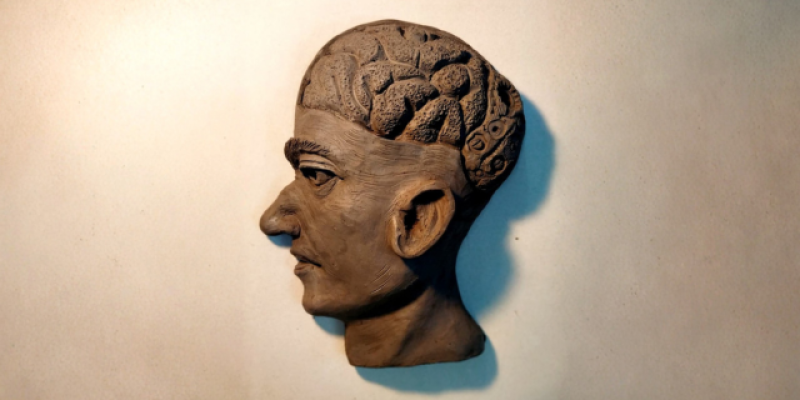
Anish Daga (1st Place) | School: Mayo College
"I wanted to make something different — most people submit paintings or digital art, so I chose to create a sculpture instead. I chose the brain because it's what truly makes us who we are, it controls every thought and function, yet we rarely stop to think about it. I shaped a head in profile, opening the skull to reveal two sides — one half a natural brain with real textured gyri and sulci, the other made of gears and mechanical parts. I wanted to show the quiet battle between natural thought and how much we now depend on machines to think and function. The face is made purely with Indian terracotta, the brain with ceramic clay."
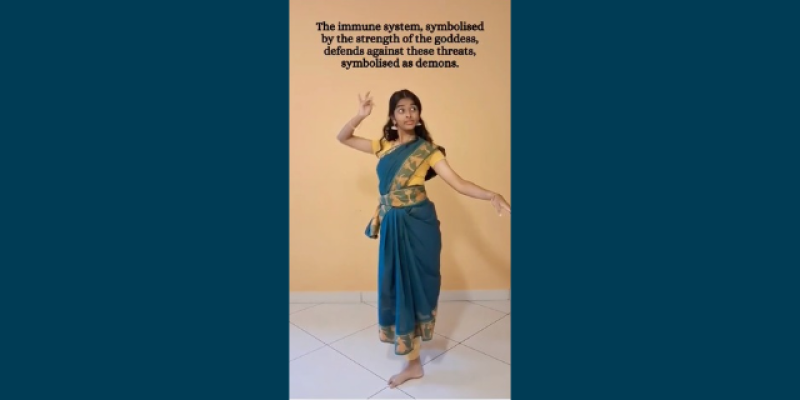
Sahana Murali (2nd Place) | School: Vidyashilp Academy
"As a student of the Indian art form of Bharatnatyam, one of the most common stories we portray is that of victory of good over evil. As I researched for this project, I realised that the same fight takes place in our "inner universe" every day: the fight between pathogens and our immune system. This dance piece showcases that struggle through a jati (strand of rhythm), where the goddess defeats a demon the same way our immune system defeats pathogens. I hope you enjoy watching this as much as I did creating it."
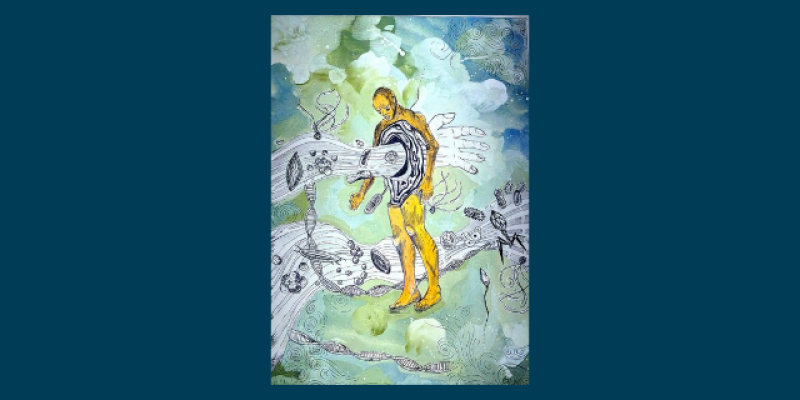
Vatsal Sarda (3rd Place) | School: Mayo College
Honorable Mentions
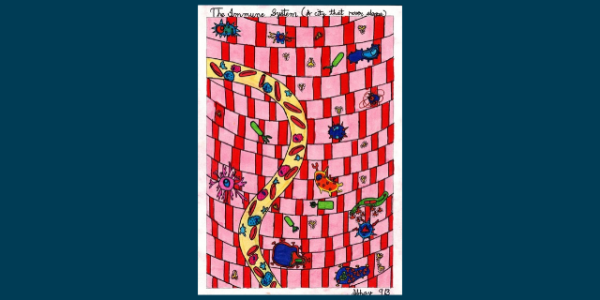
Abhay Saket Chalasani
Honourable Mention
School: Oakridge International School
"My art describes the hard work of the Immune System that never sleeps...the inner universe within our body. It shows different cells like the T Cell, B Cell, Natural Killer Cell. It depicts how Killer T Cells attack Parasite Worms that invade our body through the nose, mouth, ears. It shows the adaptable White Blood Cells (WBCs) in the blood vessel and vital platelets." (Brush & Ink Pens)
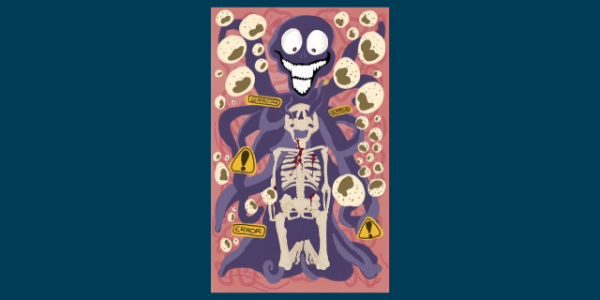
Vedha Karthika Bibilash
Honourable Mention
School: Trivandum International School
"My artwork, I have depicted the condition of autoimmunity, shown as a purple monster, which represents a B cell - a type of white blood cell. The monster is shown attacking and surrounding the skeleton. The other cells surrounding the monster represent different immune cells involved in the immune response. The “ERROR” labels and warning signs show that the immune system is making a serious mistake, but it continues the attack anyway. This determines the failure of immune tolerance, where the body no longer has the ability to properly discern or differentiate its own cells from harmful pathogens or substances. Autoimmune diseases include rheumatoid arthritis where the immune system attacks tissues around the joints. The perishing skeleton shows the effect autoimmunity on our bones and that sometimes the body's immune system can become its own enemy."
Encouragement Awards
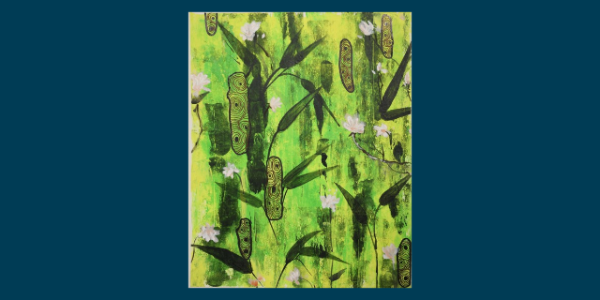
Granth Diwan
Encouragement Award
School: Mayo College
"This painting places microscopic, cell-like structures directly into a natural landscape of bamboo stems, leaves and flowers, blending the visible world of plants with the hidden world of biology. The ringed, glowing forms scattered through the scene resemble cross-sections of plant cells or spores, suggesting that the same intricate patterns we see under a microscope are quietly present in the plants around us every day. The painting reflects how biomedicine is a lens for understanding life at every scale, showing that the natural world is built from the same microscopic order." ('Hidden Order in Nature')
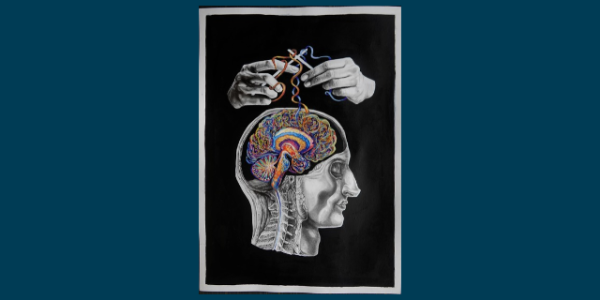
Asees Malhotra Malhotra
Encouragement Award
School: La Martiniere Girls’ College
"The biological loom, where the microscopic architecture of existence is assembled. Ribbons of the double helix, with the foundational script of life, are guided by unseen fingers. They twist and interlock, tailoring the structural scaffolding of the self. As the genetic ribbons spiral upward, the linear code of nucleic acid begins to fray into infinitely complex, electric branches. The physical blueprint seamlessly translates into a spatial network of brilliant, firing neurons. Axons stretch into the dark expanse of the cranium, catching the spark of vitality. It captures the exact boundary where molecule becomes memory, anatomy to awareness, and cold chemistry transforms into the warmth of human consciousness." ('The Biological Loom', Graphite & Acrylic)
Other shortlisted entries
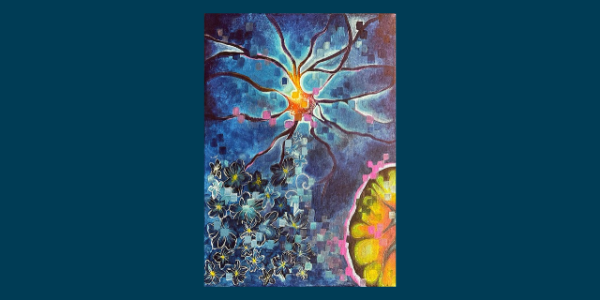
Benjamin Dmonte
School: Page Junior College, Banjara Hills
"My artwork focuses on the idea of memory and the passing of time. On the bottom left, I illustrated ‘forget me nots’, which symbolise the memories we wish to preserve and not forget. The flowers follow a pathway to the brain. I used various shard of colors to show different kinds of memories and what they mean to someone. I painted a neuron system in the middle to show the source of all remembrance and memories. Neurons pass information to the brain, constantly communicating and forming memories. The block of paint all around the painting symbolises the loss of memories of ‘fragments’ being lost through the passing of time. This artwork is close to my heart and means quite a lot to me." ('Fragments of Remembering', Acrylic)
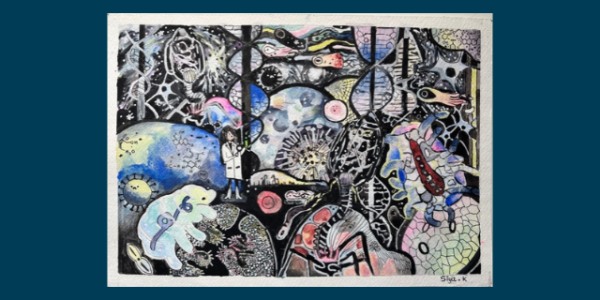
Siya Khanzode
School: MET Rishikul Vidyalaya
"My painting visualises the microscopic world of biomedicine into an expansive, surreal forest. A scientist walks among giant cellular structures, branching neurons, drifting viral and bacterial structures, bizarre microorganisms, and spiraling DNA helices. It captures the breathtaking wonder of peering through a microscope. It bridges science and imagination, rendering the invisible realm of human biology as a tangible ecosystem and a new world waiting to be explored, celebrating the dynamic interplay between art and cellular discovery." (Gouache)
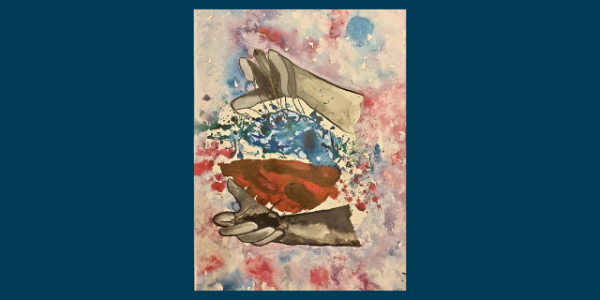
Misheeta Wadhwani
School: The Shri Ram School, Moulsari
"This artwork explores the hidden universe within us, where the brain and heart are constantly influenced by forces beyond our control. The central forms represent the mind and heart, while the surrounding bursts of colour, scattered marks and delicate lines represent social media and the overwhelming stream of external influences. The fluid, unpredictable nature of watercolour reflects how these influences gradually seep into our inner world, affecting our attention, emotions, stress, identity and decisions. Through this handmade process, I ask: Do we truly make our own choices, or are our thoughts and feelings quietly being shaped by the world around us?" (Watercolour)
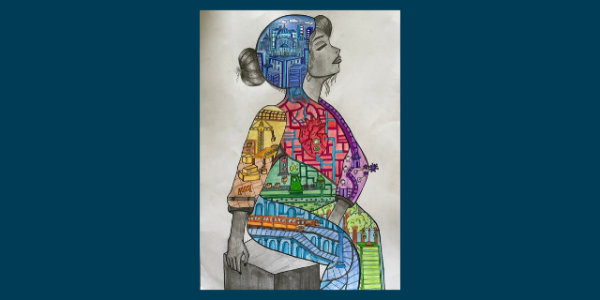
Mira Lojith
School: Trivandrum International School
"My artwork portrays the human body as a bustling city yet a tranquil outside. It reveals the complex systems hidden beneath our everyday appearance. Each section represents a part that helps the body function perfectly. The girl is shaded in black and grey, creating a serene presence, while the vibrant city represents constant energy and activity that occurs within - both body and mind. This highlights that although the body may appear still and peaceful on the outside, an entire universe is constantly working from inside."
Other shortlisted entries
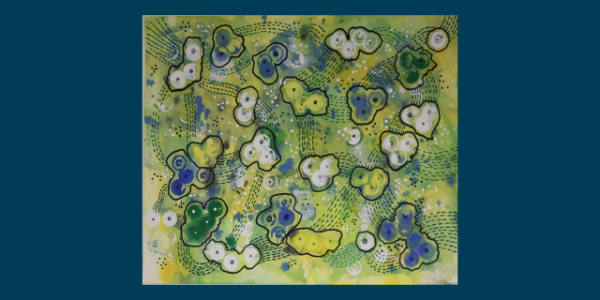
Manan Agarwal
School: Mayo College
"This painting shows lots of amoeboid forms scattered across a background of green and ochre, like colonies of cells seen under a microscope. Each shape has its own circles inside, like a nucleus or other cell parts, and dashed lines flow around them, connecting everything together like invisible currents. I wanted it to feel like cells actually behave: growing, spreading, and connecting to each other without any one shape being more important. Just like in our body, cells don't work alone. They multiply, communicate and organise themselves naturally, and that quiet coordination is what keeps living things alive."
Anandini Shenishetty
School: Rockwell International School
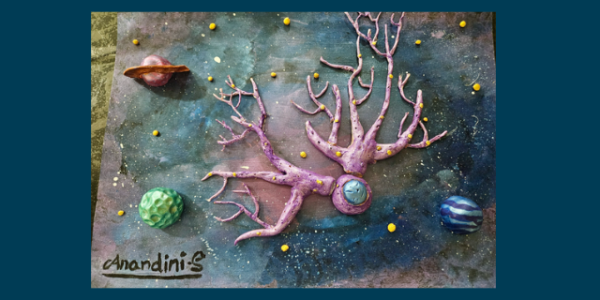
"My project is inspired by the remarkable purkinje cell, one of the most complex neurone in the human brain. I explored ideas with the help of AI to understand its structure and present it creatively. I imagined the purkinje cell has a universe because its countless branches resemble galaxies, star and cosmic connection symbolising the endless possibilities with in our minds. this art work combines neurone science and art to show that every tiny brain cell contains extraordinary beauty and complexity. Through this model, I hope inspire curiosity about the hidden universe inside the human brain and the importance of scientific discovery."
Khwaish Salkar
School: The Universal School, Ghatkopar
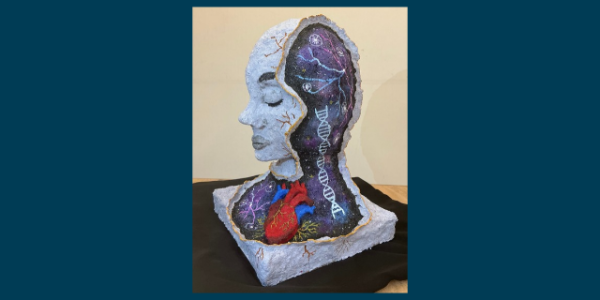
"My artwork explores the human body revealing the complex biomedical world hidden beneath its surface. A human figure opens into a galaxy containing cells, organelles and a DNA double helix, connecting the microscopic scale of biology with the vastness of the cosmos. A three-dimensional heart and branching vessels represent circulation, life and interconnected biological systems. The cracks reveal this hidden world and are inspired by Kintsugi, with gold-like edges transforming fractures into pathways of discovery and value. Using sculpture, colour, texture and symbolism, I combine art and biomedicine to make invisible biological structures tangible, showing that beneath every human exterior exists an intricate universe of life." (Paper Pulp, Cardboard and Paint)
Aarav Jain
School: MET Rishikul Vidyalaya
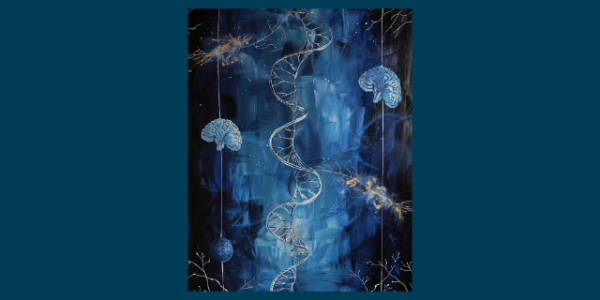
"My artwork depicts the human body as a vast and unknown cosmos. The DNA helix in the center represents the foundation of life, like a glowing constellation. The brains and cells floating around represent human consciousness and biology. The branching pathways and stardust symbolize both the neural and cosmic elements. By combining these biological and cosmic elements in a vivid and painterly style, my artwork aims to depict the awe-inspiring and hidden universe that exists within the human body invisibly to those observing it."