Scientists develop early-warning tool to detect Buruli ulcer hotspots before human cases occur
A new approach developed by researcher including Prof Tim Stinnear & Dr Andrew Buultjens, Dept of Microbiology & Immunology (DMI), can flag emerging Buruli ulcer hotspots two to six years before infection occurs, using possum excreta surveillance and cutting-edge genomics.
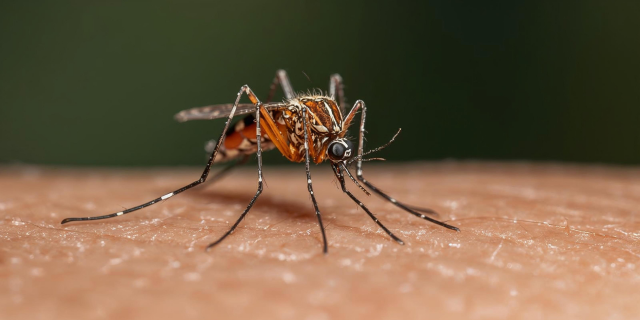
Mosquitoes have been confirmed as the vector of Buruli ulcer in Australia
The findings mark an important advance in early warning for this debilitating skin disease spreading across Victoria.
Buruli ulcer, a serious skin infection caused by the bacterium Mycobacterium ulcerans, has a long and variable incubation period, making it difficult to pinpoint where patients were exposed. Although considered a neglected tropical disease, Victoria continues to see rising incidence and geographic spread.
Recent research led by the Doherty Institute confirmed that, in Australia, mosquitoes transmit M. ulcerans to humans (Mee , Buultjens et al, 2024), and that native possums can also get Buruli ulcer and shed the bacteria in their excreta (Vandelannoote et al, 2023).
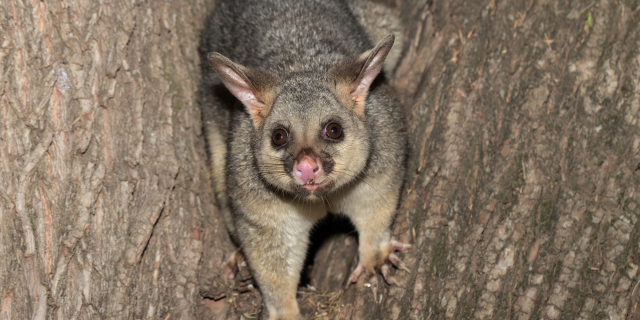
Researchers want to better understand possum populations and the bacteria they shed to map future Buruli ulcer hotspots.
Focusing on Melbourne’s inner northwest suburbs (Brunswick West, Pascoe Vale South, Essendon, Moonee Ponds and Strathmore) and the Geelong suburb of Belmont, researchers analysed M. ulcerans DNA in possum excreta and compared it with bacterial DNA from human cases to determine whether infections were locally acquired.
“We know possums have very small home ranges, so the presence of M. ulcerans in their excreta is a highly reliable indicator that the bacterium is present locally,” said Dr Andrew Buultjens, Senior Research Fellow in DMI at the Doherty Institute and first author of the recent paper published in the journal Applied and Environmental Microbiology.
By using DNA sequencing to compare bacterial genomes from possum-derived and human-derived M. ulcerans, we found that clusters of positive possum samples closely matched the locations of human cases. This clear spatial overlap confirms that transmission in both Melbourne’s inner northwest and Geelong is occurring locally.
Using advanced genomics modelling, the team also estimated that M. ulcerans was introduced to these areas two to six years before the first human cases appeared locally.
“This research shows we don’t have to wait for people to become infected before we know an area is at risk,” said Professor Tim Stinear, Director of the WHO Collaborating Centre for Mycobacterium ulcerans and lead author of the study.
“Forewarned is forearmed,” said Professor Stinear.
“Our method, combining environmental surveillance and genomic fingerprinting, allows us to identify emerging hotspots early. As Buruli ulcer continues to expand into new areas, it offers a scalable, proactive model to protect communities, to protect wildlife and to guide early public health interventions in other affected regions.
“This early warning system provides critical knowledge for targeted public health measures, such as community messaging and alerting local clinicians, to reduce exposure and ensure timely diagnosis and treatment.”
This integrated approach - linking wildlife, environment and human health - is a striking example of One Health in action. By better understanding possum populations and the bacteria they shed, scientists can now map future Buruli ulcer hotspots with unprecedented precision.
In Australia mosquitoes are confirmed as the carrier and transmitter of the Buruli ulcer, people can protect themselves by using repellents, wearing long sleeves and avoiding mosquito bites in the Buruli ulcer hotspots.
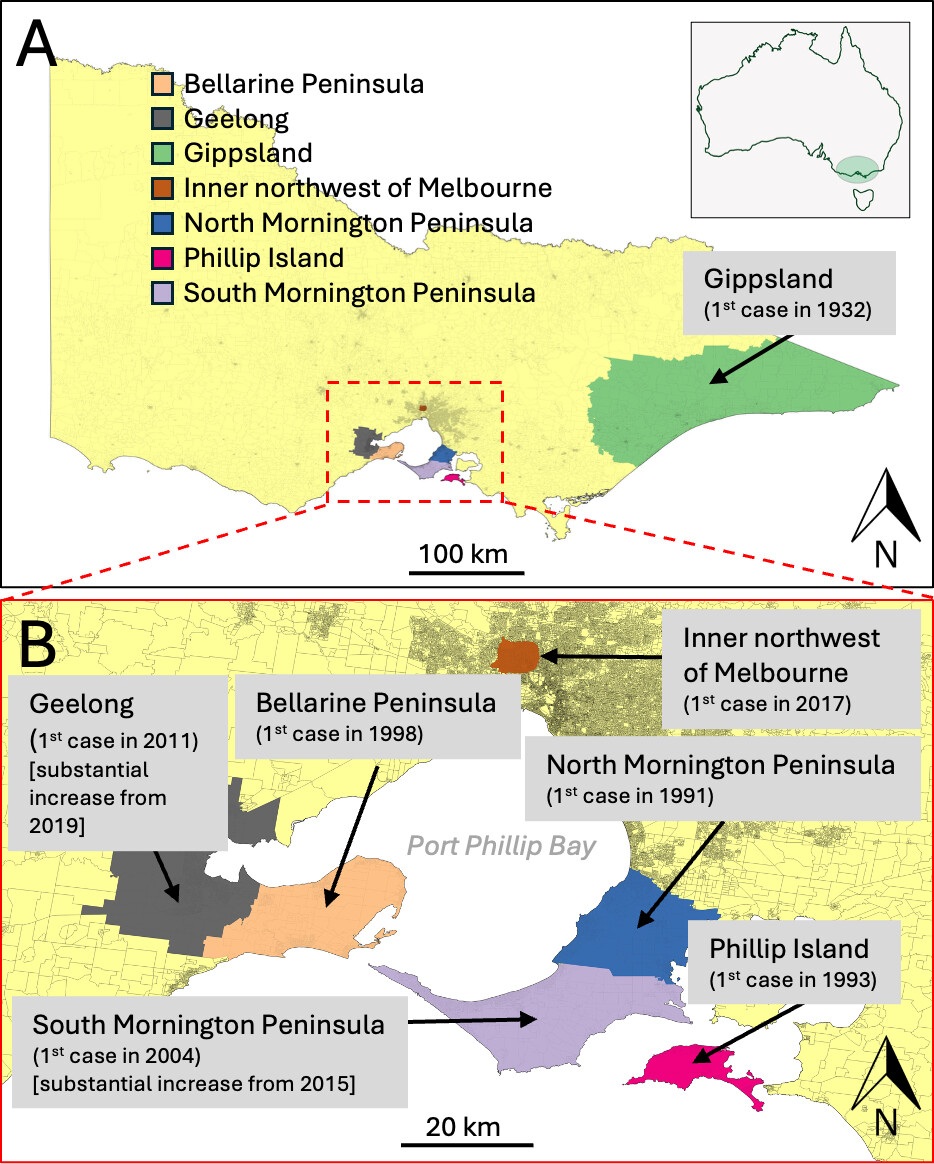
Image: Map of major BU endemic areas in southeastern Australia. (A) Regional context of the BU endemic areas within the state of Victoria and inset shows national context; (B) BU endemic areas within the Port Phillip Bay region. The basemap depicts population density (boundaries of 2011 census data meshblocks), and all endemic areas are labeled with the year of first BU case. (Source: https://doi.org/10.1128/aem.01602-25)
This article was originally published by the Doherty Institute on 18 December 2025.
The Doherty Institute is a joint venture between The University of Melbourne and The Royal Melbourne Hospital.