Strength in numbers - MND researchers share their inspiration for finding a cure this Global MND Awareness Day
Global Motor Neurone Disease (MND) Awareness Day is 21 June.
Affecting the motor neurons responsible for muscle movement, Motor Neuron Disease (MND), also known as amyotrophic lateral sclerosis (ALS), is a group of neurodegenerative disorders. Despite dedicated research, genetic discoveries and clinical trials, a cause and cure has still not been found.
approx. 140,000 new cases of Motor Neurone Disease are diagnosed annually
Each year Global MND Awareness Day is used to express hope that one day there will be a turning point in the search for cause, treatment and cure of this disease.
Awareness of this debilitating disease has increased significantly since AFL football legend Neale Daniher’s diagnosis in 2013, he is the co-founder and patron of the Fight MND organisation that has raised awareness and invested heavily in research through the Fight MND Cure Fund – one of the world’s largest funders of MND research.

Image: The Age Newspaper
Greater than the sum of our parts: The diverse, complementary approaches to tackling MND at the School of Biomedical Sciences
Despite the severe impact that it has on afflicted individuals, motor neuron disease (MND) would at first pass appear to be a relatively straight-forward biomedical issue to address. Motor neurons are the specialised nerves cells that control muscle function and the symptoms of MND arise when these nerves cells deteriorate and die. All that’s required is a treatment that stops motor neurons from dying.
Unfortunately, there is no cure for MND and existing approved treatments are of marginal benefit. So although the initial symptoms of slurred speech or weakness in a hand are generally mild, the fact that motor neurons have no capacity for renewal means the impact of motor neuron loss escalates without respite. Nobody recovers from MND and most will die paralysed within 3 years of diagnosis.
The motor neurons we are born with, are the motor neurons we take to the grave, and for most people this means our motor neurons are not the rate-limiting factor for life. This situation is flipped in MND and the challenge herein is that the reasons why motor neurons die in MND remain essentially unknown. Most cases of MND are sporadic and without a clear genetic basis. But even in those cases where the cause is unequivocally a known heritable genetic mutation, the cellular events that link that genetic mutation to motor neuron death are far from clear.
Effective treatment of MND will necessitate clear understanding of why these critical neurons die prematurely. Here at the School of Biomedical Sciences we have several research groups addressing this elusive and unresolved medical issue.
A/Prof Peter Crouch
Dept of Anatomy and Physiology
I’m naturally inspired by scientific pursuit. I love the problem-solving, the experiment design, and the interpretation of the new knowledge that we generate. By applying this to MND I know that we’re doing the right thing for a lot of people who need our help.
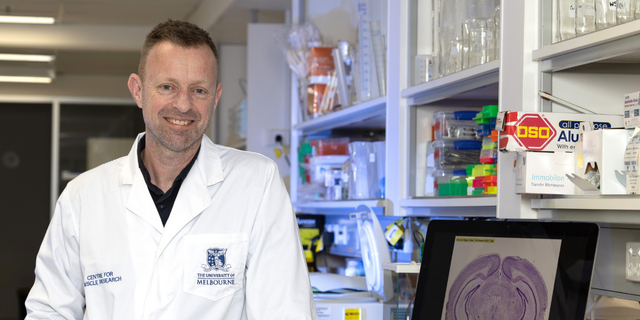
Project - Targeting mitochondria in the central nervous system to treat MND.
Mitochondria produce the chemical energy that sustains life. Their function is altered in the MND-affected central nervous system and this has detrimental ramifications for energy-hungry motor neurons. This project will assess a new compound for therapeutic potential in the treatment of MND. The mechanism of action of this compound involves inhibition of a specific mitochondrial enzyme. Related compounds that target the same enzyme are used for treating other human diseases, but their utility in treating MND is unresolved because of their limited ability to reach the central nervous system. The new compound that A/Prof Peter Crouch and his team are assessing exhibits superior capacity to reach the central nervous system. Success with this project will be two-fold. First, the mitigation of disease-associated symptoms following treatment with this compound will clarify the role that mitochondria play in the death of motor neurons in MND. Second, positive outcomes from this project will provide a strong scientific and commercial basis from which to initiate clinical translation of a new therapeutic strategy for MND.
Dept of Biochemistry and Pharmacology

Project - Inhibiting toxic neuroinflammation to treat MND
Inflammation within the central nervous system, termed neuroinflammation, is evident in cases of MND and has consequently attracted considerable attention as a potential therapeutic target. The protein STmulator of INterferon Genes (STING) is a key molecule that is involved in the coordination and regulation of the neuroinflammation that is seen in MND. Prof Peter Crack’s team has identified a unique region in the STING protein that they feel is a druggable target. Developing a small molecule that can bind to this region will enable controlled regulation of the function of STING. It is anticipated that this regulation will in turn lead to a decrease in inflammatory mediators that contribute to the pathology or MND. Peter’s project will leverage their advanced computer-aided drug design and pharmacological characterisation capabilities paired with world class drug synthesis facilities, in-house developed and conducted in vitro/in vivo models and an innovative approach developed after more than a decade as a leader in the drug discovery research field. The successful realisation of this project will establish the basis for a neuroprotective therapeutic that can be administered orally to people afflicted with MND.
Dept of Biochemistry and Pharmacology
I am inspired by the need to find new treatments for this devastating disease. We still do not understand enough what triggers the disease process, and my goal is to determine the molecular mechanisms involved, which is how we can devise therapeutics to prevent disease from starting or progressing.

Project - Trouble at the ribosome
Prof Danny Hatters is tackling MND by examining a genetic feature of MND that results in abnormal expansion of arginine-rich dipeptide repeat sequences in some proteins. These expansions are common in a relatively large proportion of MND cases. Danny and his team have identified that when cells attempt to make these abnormally expanded proteins, the arginine-rich regions cause blockage at the ribosomes, the cellular machinery that is required for healthy protein synthesis. Danny is examining why these expanded proteins become blocked on the ribosomes and how the ribosomal blockage can cause motor neuron death. Additionally, Danny is examining whether there are dormant mechanisms in cells that can be activated to stimulate the removal of the blockages, including existing mechanisms designed to help faults in ribosomes during normal protein synthesis. An exciting potential impact will be in the identification of one or more genes that can alleviate toxicity of stalled ribosomes, thereby opening up new opportunity for as yet unexplored therapeutic intervention.
Dept of Anatomy and Physiology
The thrill of making discoveries by following the data with integrity, unconstrained by the status quo, to reveal fundamental aspects of the disease and create new opportunities for treatments.

Project - Multiomic interrogation of neurotoxic glia
Dr Jeffrey Liddell’s approach to MND is to step away from the historical neuron-centric approach to understanding MND and broaden perspective to include the likely involvement of other types of cells in the central nervous system. Non-neuronal cells (collectively referred to as glia) outnumber neurons in the central nervous system and their presence is essential for healthy neuronal function. But in MND these glial cells become corrupted and toxic towards motor neurons. Jeff has identified a factor that is present in the central nervous system of human cases of MND which, if applied to glial cells grown in a dish, drives them into a neurotoxic state. Jeff is applying multiple advanced approaches to thoroughly characterise these neurotoxic glial cells and their interactions in order to determine how they kill neurons. This approach is expected to facilitate the discovery of neurotoxic factors released by diseased glia and thereby afford opportunity for effective, disease-modifying intervention that can complement neuronal-centric approaches.