Leading MDHS Advancing Health Impact Mission – Curing Chronic Disease
Congratulations to Prof Stuart Mazzone, Dept Anatomy & Physiology, appointed co-lead for the Curing Chronic Disease Impact Mission by the Dean. Previously known as Impact Domains, the aim of this Impact Mission is to develop cures for selected chronic disease which have global impact, high morbidity, prevalence and cost burden and where we and our partners have expertise. Stuart will co-lead the mission with Prof Laura Downie, Dept Optometry & Vision Sciences.
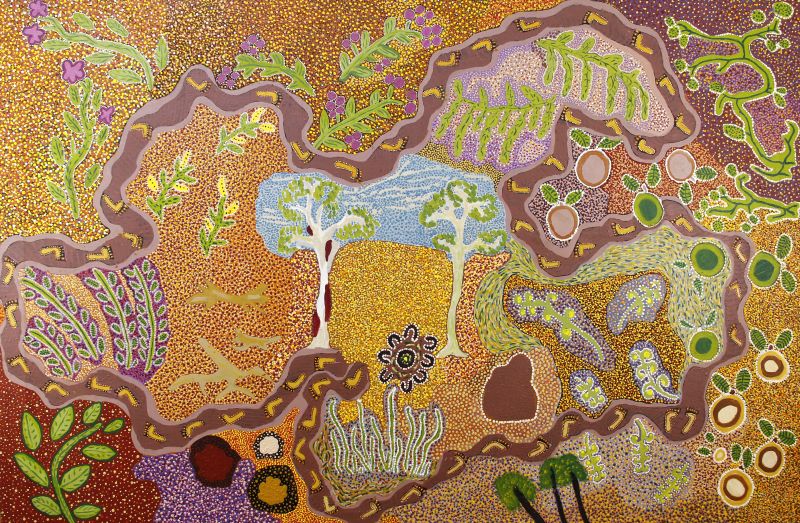
Image: Bush medicine: a collaborative work by women from Wirrimanu (Balgo)
Ahead of the formal launch by MDHS in 2025 we asked Stuart about the importance of the mission, his vision and strategy for tackling this bold ambition and how people can get involved to make an impact.
In Australia, half of us live with a chronic health condition, many of which are challenging to manage because of a lack of effective treatments and cures. Healthcare systems are overwhelmed by the burden of chronic disease, and this is a profound societal challenge.
“We need a world where equity is the cornerstone of healthcare and proactive prevention, guided by research that enables wellbeing for all.” Stuart said of the importance of this initiative. “A connected health care system will eliminate waste and deliver the right health care to the right people at the right time.”
This role is an opportunity to re-imagine how we tackle some of the world’s most significant chronic health challenges.
An ambition to cure disease, requires a different approach to traditional research. Stuart plans to adopt a Mission-oriented approach, with coordinated efforts that leverage multiple disciplines and sectors, state-of-the-art platform technologies, and incorporate a breadth of perspectives to drive innovation that delivers real-world benefit.
“We foresee this being achieved by aligning our existing foundational strengths in biomedical and medical research across the Parkville precinct, and with the capabilities of our partners including our colleagues across different Faculties and Universities, Medical Research Institutes, Community Health Networks, Consumer Groups, Industry and Government.”
We define a cure as a transformative advance over current care, that substantially relieves morbidity and truly delivers positive impacts that are meaningful for people with lived experience of the condition.
Stuart and Laura are currently working to develop a framework and guiding principles to underpin the pathway forward. This will include an expression of interest process for project ideas.
Stuart advised there will be many opportunities to become involved in mission projects as teams are built around bold and innovative ideas. These opportunities will extend to emerging research leaders and students, to leverage greater diversity and longer term sustainability. So keep an eye out for more information on how you can contribute!
By creating these transformative approaches to care we can redefine how people with these health conditions live their lives.
In 10 years, we foresee success being defined by:
- new intellectual property translated into products and services,
- the advancement of Australian-led innovation and enterprise,
- improved health and wellbeing of communities globally,
- reduced healthcare burden from chronic disease,
- advancements in research training, and
- inspiring early career researchers and students to fulfil an integral role in shaping the future of healthcare.

Stuart Mazzone is a Professor of Neuroscience, Dept Anatomy & Physiology, School of Biomedical Sciences, where he also serves as the Director of Research, Deputy Head of Department, and Head, Respiratory Sensory Neuroscience Laboratory.
Find an Expert | Respiratory Sensory Neuroscience Laboratory
School of Biomedical Sciences, 12 February 2024, 'Rethinking chronic cough: is the brain to blame?"
Pursuit Podcast, 25 November 2020, 'The science of coughing'
Research Higher Degree Experience, 'In the Lab with Prof Stuart Mazzone'
Learn more about the MDHS Advancing Health Impact Mission Initiative.
Advancing Health 2030 is our new strategic plan, focused on driving progress in health and medical sciences through collaborative innovation and transformative research. As we tackle the health challenges of a changing world, we’re committed to making a real difference in the lives of communities locally and globally. Together with our partners, we aim to position Melbourne as a global leader in health impact and innovation.