Cancer research facility at Bio21 Institute launches after funding boost
Official opening of two state-of-the-art cancer research facilities in the Biomedical Parkville Precinct, funded by the Australian Cancer Research Foundation (ACRF) set to transform cancer detection & treatment.

Image: Prof Michael Parker, Director of Bio21 Institute features on Sky News Australia
Both of the ACRF-funded programs will help transform the way cancer is detected or treated, for the 165,000 Australians predicted to be diagnosed with the disease in this year alone.
$2 million was awarded to the Bio21 Institute to establish a world-class research facility, the ACRF Facility for Innovative Cancer Discovery. The facility was officially launched earlier this month with the funding used to purchase powerful technologies to assist medical researchers in the discovery of new cancer drugs.
Professor Michael Parker, Director of Bio21 Institute & Head of the Parker Lab in the Dept of Biochemistry & Pharmacology, was interviewed by Sky News Australia and talked about the new research facility and the importance of using breakthrough technologies, including Artificial Intelligence, to find new cancer treatments. Watch the interview on Sky News here.
Specifically, the facility's research program will focus on drug discovery for cancers with no approved therapies or where existing therapies are associated with bad side-effects. Using state-of-the-art equipment, the program will explore the use of ‘structural biology approaches’ to assist with the discovery of new medicines and treatments. It will enhance the early-stage translation of basic cancer discoveries made by Australian researchers into new cancer treatments.
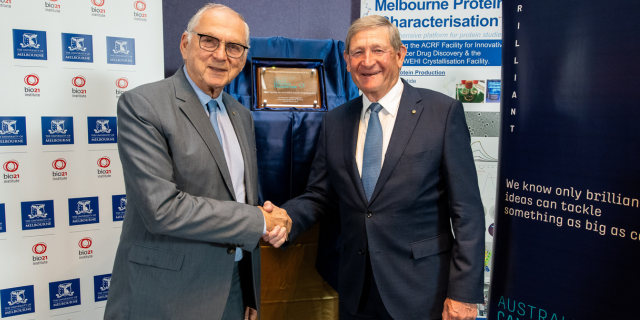
Image: Professor Jim Angus AO (previous Dean of MDHS, now Lieutenant-Governor of Victoria) officially opened the research facility at the Bio21 Institute in March - pictured with Mr Tom Dery AO, Chair of ACRF (left)
Prof Michael Parker said the ACRF funding has made it possible to create the facility and provide research partners with tools to develop and deliver new cancer drugs.
The facility houses some of the most cutting-edge structural biology instruments and technologies and will cater for the cancer research community in the Melbourne Biomedical Precinct and beyond.
The funding contributed to early stage drug discovery tools to accelerate the discovery and development of drug-like compounds - including a BiaCore, virtual screening licences and a 19F Bruker 500 MHz NMR instrument.

Image: Prof Malcolm McConville (DBP), Prof Kaylene Simpson (Honorary Professor in DBP), Prof Eric Hanssen (Head of the Bio21 Ian Holmes Imaging Centre and Honorary Professor in DBP), Paul-Marie Beau (RIC) at the launch of the new research facility at the Bio21 Institute in March
Structural biology is revolutionising cancer drug discovery and advancing patient outcomes. It has been instrumental in developing highly effective medicines to treat a range of cancer types. The development of successful targeted molecular medicines includes Imatinib (Gleevec) to treat myeloid leukaemia, Venetoclax for leukaemia, and Gefitinib for lung cancer.
(ACRF)
Funding was also awarded to Peter MacCallum Cancer Centre to establish the ACRF Radiation Immuno-oncology Program to explore opportunities to utilise radiation-based treatments to harness the potential of a patient’s immune system.
The interview, featuring Prof Michael Parker, also appeared on news.com.au and the Daily Telegraph online.
About the Bio 21 Institute
The Bio21 Molecular Science and Biotechnology Institute is a flagship University of Melbourne interdisciplinary institute focused on molecular life sciences. Bio21 hosts some of the biggest and most successful platforms of scientific equipment in the nation.