$2.5 million fellowships awarded to research on lifelong immunity and AI-designed proteins
Researchers Dr Rhys Grinter (DBP, Bio21 Institute) and Dr Carolien van de Sandt (Honarary, DMI) have received CSL Centenary Fellowships, valued at $1.25 million each.
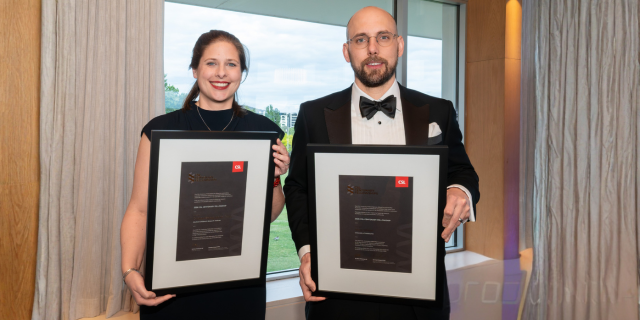
Image: Dr Rhys Grinter (right) and Carolien van de Sandt
The funding will be used to lead breakthroughs in lifelong immunity research and AI-designed proteins, over the next five years.
The fellowships were officially presented during the Australian Academy of Health and Medical Sciences Annual Meeting, held on Wednesday 29 October in Canberra.
Making proteins with AI: Dr Rhys Grinter, Department of Biochemistry and Pharmacology, Bio21 Institute
Dr Rhys Grinter is transforming drug development by harnessing Nobel Prize-winning AI technology to design new proteins. His innovative approach streamlines the production of these proteins in the lab, delivering potential drugs many times faster than traditional methods.
Rhys will use his $1.25 million CSL Centenary Fellowship to target a group of proteins that regulate a host of fundamental cellular processes and play a role in many diseases including cancer, metabolic dysregulation, heart disease and infertility. He hopes to develop a range of potential drugs to treat these diseases. His longer-term vision is to build and share a protein development capability that will fast-track drugs to patients.
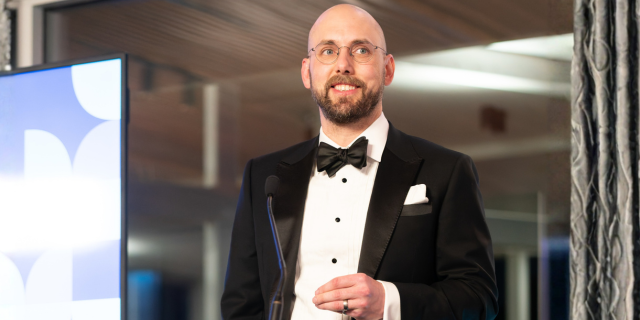
Could we all have lifelong robust immunity? Dr Carolien van de Sandt, Honorary in the Department of Microbiology and Immunology
Dr van de Sandt’s fellowship supports her groundbreaking work on lifelong immunity. Carolien is tackling the challenge of immune system ageing, a key factor in vulnerability to viruses and declining vaccine effectiveness. Her research explores how, as we age, our T-cells become less effective at fighting acute viral infections and less flexible in responding to novel viruses.
Carolien will use her $1.25 million CSL Centenary Fellowship to study how children generate robust immunity, how healthy adults maintain optimal immunity, and how immunity becomes impaired in most older people and in certain other population groups. She will also identify targets that could be used to restore our immune systems as we age.
Dr Michael Wilson, CSL Senior Vice President, Head of Research said: “Dr van de Sandt and Dr Grinter are both conducting fundamental research in their respective fields of immunology and drug discovery...with the support of the CSL Centenary Fellowships, their research will hopefully transform how we protect health and accelerate the development of essential new medicines."
This article was originally published by UniMelb on 30 October 2025.