Meet our inspiring alumni
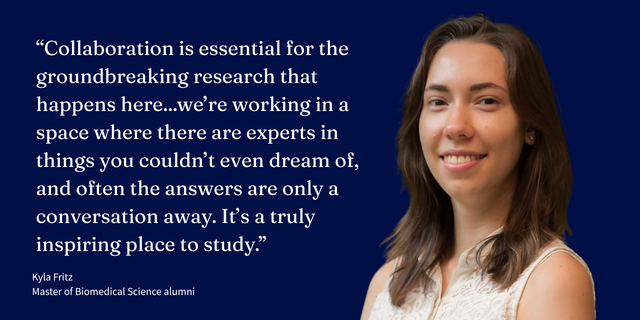
Meet Kyla
Bachelor of Biomedicine and Master of Biomedical Science alumni Kyla Fritz, says studying at UniMelb opened doors to opportunities and helped her uncover her strengths and interests.
-
My curiosity developed as I learned about how complex biology actually was. The scope of what we know as concrete fact is so narrow; it’s actually incredibly intricate and full of unanswered questions!
Dr Martin Borch Jensen explains it best:
Curing a disease is like finding a specific bug in millions of years of vibe-code.. we have an idea of what we want to do, but we’re not sure what the rules of our system are. Even sending rockets to space is a much more predictable kind of engineering.
In this way, even though humanity has learned so much about biology and the human body in the past 100 years, there is still an abundance of discoveries to be made and much we don’t yet understand. Even contributing a small piece to that evolving knowledge leads to more questions - that endless opportunity is interesting to me.

-
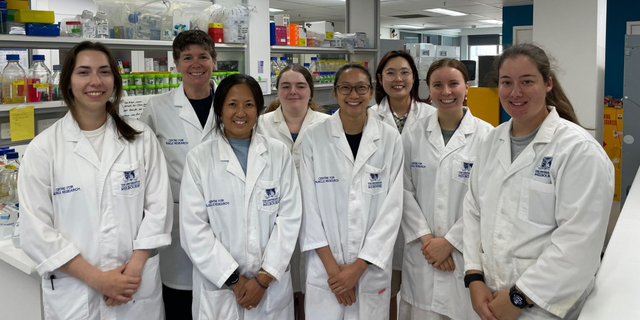
One highlight was a heavily lab-based, group-focussed subject: I was eager for hands-on experience after being online for two years and it was great to work in a physical lab environment! Our group developed a fantastic dynamic and the experience deepened my appreciation for teamwork in scientific research. It was a fantastic reminder of how energising hands-on science can be.
-
My research focus was on improving muscle stem cell differentiation using compounds derived from fruits. I spent a lot of time working in large biosafety hoods, growing and monitoring millions of cells, photographing them on high content microscopes and conducting image analysis. Another highlight was data presentation, it was nice to have all the numbers in one place and try to piece them together to tell the story of the data most accurately, and making it visually appealing. I have a background in fine art and it was nice to be able to marry together the science and the visual aspects to clearly and elegantly communicate my findings.
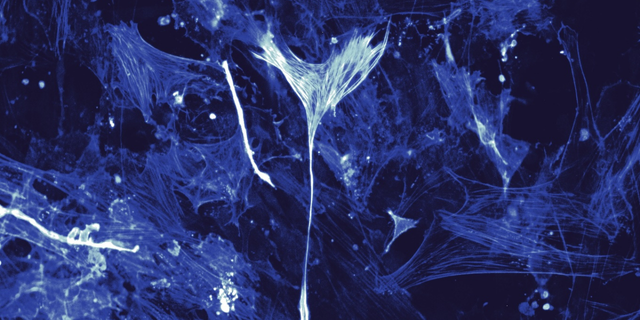
Image: Kyla received the People's Choice Award, Best Image in the 2025 Under the Coverslip image competition for "Cyanotype"
My research environment was also very collaborative - I got an office space within the lab and worked alongside the 20-or-so students who were also researching, as part of their Honours, Masters and PhDs - which fostered constant learning and shared discovery and inspiration.
-
Time management and project management skills as I was extremely hands-on with my research project.
Technical experience with laboratory techniques including cell culture, animal handling and ethics, qPCR, Immunohistochemistry and microscopy. You learn about a lot of these in undergrad but it’s different when you get to apply it to different research goals. It really solidifies your learning.
So much knowledge of cutting edge science - our classes were often taught by researchers at the University, who are experts in their field.
And importantly mentoring and friendship - from our classes and research environment, having both of these is very serendipitous but I feel lucky to have met amazing people through both aspects!
-
We were right at the doorstep of world-class facilities and a buzzing research ecosystem. Our proximity to leading institutes meant that there were often opportunities to attend seminars, collaborate on projects, and access specialised technologies. We used neighbouring facilities like specialised microscopes, tissue processing machinery, mass spectrometers for protein analysis, high-throughput compound libraries, and even irradiation apparatus for their specific projects. The learning curve is often steep but it feels like a once-in-a-lifetime opportunity! Collaboration is essential for the groundbreaking research that happens. We’re working in a space where there are experts in things you couldn’t even dream of, and often the answers are only a conversation away. It’s a truly inspiring place to study.
-
Stay connected to what genuinely energises and inspires you! There is often lots of advice about taking every opportunity that is offered, but I would suggest being more discerning. Sometimes it feels like you should do everything, but your time is limited and valuable. Try to focus on what energises you, brings you joy, and makes you feel peaceful. Finding what makes you flow, even if it seems unconventional at first, might ultimately lead you to a meaningful area of expertise nobody has reached before.
