Prof Laura Downie – reframing ‘failure’
Prof Laura Downie inspired EMCA’s at the SBS Retreat in June 2024 with her discussion around the traditional views of success and failure - how reframing into a growth mindset, as well as perseverance and hard work, can move us a step closer to achieving our goals.
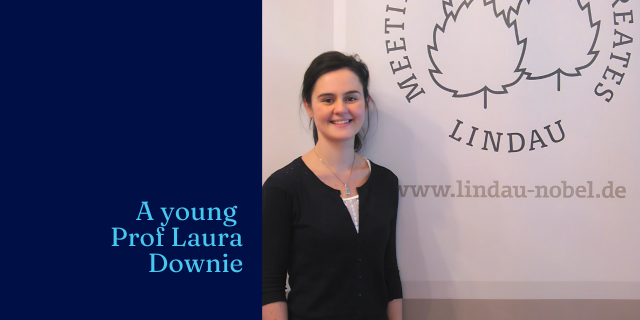
Image: A young Prof Laura Downie, at the Meeting of Nobel Laureates.
I think it is important to acknowledge that, inevitably, we often hear selectively about successes – the successful grants and the impactful projects. However, beneath these successes there are often a range of rejections.
I once heard a highly regarded senior academic speak about their 'CV of Success' and a separate, personal 'CV of Failures', with the latter providing an opportunity for them to internally reflect and learn, with a growth mindset, on how to develop their skills as a pathway to future success.
My view is that it is important to celebrate our successes, but also develop mechanisms of resilience to see us through the tougher times. I have always found it useful to set smaller goals that are achievable, and work towards them, step by step. In this way, small successes create a pathway to larger impact.
We have an opportunity to reframe our perspective on 'failure'.
When we are at school, in a structured learning/assessment environment, we often think about 'failure' in the context of examinations, where there are clearly-defined right and wrong answers to questions, and if we don't answer enough questions correctly, we 'fail' the exam.
As academics, we are frequently pushing the boundaries of knowledge. We are often seeking to answer complex questions that don't yet have answers, through innovation and creativity, and hard work. In seeking to answer these challenging questions we have to be able to embrace risk, and to acknowledge the potential risk that something, such as an experiment, will not be successful. But, does this form of being 'unsuccessful' really constitute 'failure'?
In the context of overcoming challenges faced when inventing the incandescent light bulb, Thomas Edison is famously quoted as saying "I have not failed. I've just found 10,000 ways that won't work". Each unsuccessful attempt was viewed as eliminating a potential solution that wasn't going to give the desired outcome, thereby moving him closer to a viable solution.
By persevering through individuals setbacks, and learning from these past non-successes, we are potentially moving one step closer to achieving our goals, which might even be a solution that could forever change the world.
Prof Laura Downie, Dame Kate Campbell Fellow, is head of the Anterior Eye, Clinical Trials and Research Translation Unit in the Department of Optometry and Vision Sciences, Melbourne School of Health Sciences, Faculty of MDHS
The research in Prof Downie's laboratory aims to advance knowledge about ocular surface biology, identify biomarkers to improve the detection and monitoring of disease, and evaluate new therapies to advance eye care. Through interdisciplinary collaboration, their research bridges discipline silos, to drive creative and innovative science. This research has a strong translational focus, integrating discovery research, clinical trials and knowledge translation.
My research vision is to advance eye care and improve patient outcomes, by leading and inspiring innovative research that drives transformational changes in practice. To ensure the relevance and reach of our research to the broader community, my team and I are highly engaged with industry, clinicians, consumers and external bodies. I am also passionate about fostering a diverse and cohesive team environment, where each person is supported to flourish, through mentorship and sponsorship.