Spotlight on Therapeutics: Could lab-grown human tissue models transform how we respond to the next pandemic?
When it comes to understanding how diseases work and which therapies might be successful, animal studies form a critical step in the pathway to human trials. But animal models and laboratory cell-line testing methods don’t always predict how human bodies respond.
When it comes to understanding how diseases work and which therapies might be successful, animal studies form a critical step in the pathway to human trials. But animal models and laboratory cell-line testing methods don’t always predict how human bodies respond.
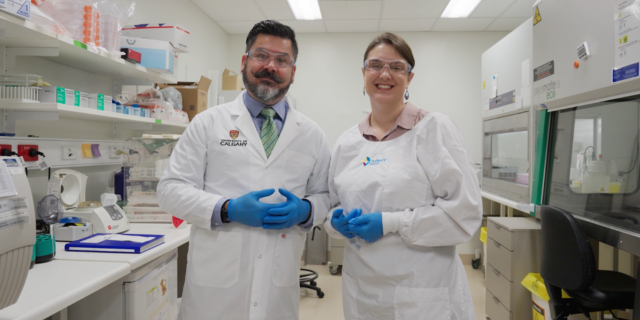
Finding new ways to effectively understand disease pathways and potential therapeutics quickly and rapidly is essential in preparing for the next pandemic, and a transatlantic collaboration between Dr Simon Hirota at the University of Calgary, and Dr Laura Cook (Dept of Microbiology & Immunology at the Doherty Institut, aims to change that. Their project is pioneering a standardised platform to grow human lung and gut organoids in laboratories – a project that, if successful, could dramatically improve human clinical trial success rates.
What are organoids?
Organoids are miniature, lab-grown models of human organs made from actual human cells, like tiny living replicas that scientists can study without infecting an animal or a person.
Given the number of therapies that perform well in animal studies, only to fail in human trials or cause unpredictable adverse impacts, lab-grown human organoids offer a more accurate window into human biology.
The critical factor
Organoid technology has only existed since 2009, and while it is advancing rapidly, consistency has been a fundamental problem in global adoption.
“Each lab is currently using its own recipe to grow organoids – and if we’re all using different protocols, we can’t collaborate, compare, or reproduce each other’s results,” Dr Hirota explains.
Dr Cook adds: “Science is grappling with a reproducibility crisis where a significant proportion of findings published in leading journals can’t be independently replicated. In pandemic preparedness, where speed and confidence are critical, this is a serious problem.”
The project’s central mission is to harmonise gut and lung organoid protocols between the two laboratories in Melbourne and Calgary, creating a shared, validated foundation that the global research community can build upon. This means rigorously testing every step of the process, swapping tissue samples between Melbourne and Calgary, and confirming that both labs can produce the same results from the same starting materials.
The process has added complexity via the integration of immune cells into the models. This is essential for testing host-directed therapeutics, which are treatments that work by modifying the body’s own immune response rather than targeting the pathogen directly.
“You need the added immune cells to be able to test therapeutic activity on inflammatory responses,” Dr Cook explains. “But immune cells can behave unpredictably in organoid conditions, requiring careful optimisation.”
The team has spent four years refining these co-culture conditions and are now collaborating to establish the standardised protocols.
What is the blue-sky vision?
The goal is to establish a standardised, validated gut and lung organoid platform that can be rapidly deployed in the event of another pandemic.
Harmonised protocols and a bank of well-characterised human organoid models would enable researchers worldwide to quickly deploy models, investigate disease pathways and screen potential therapeutics –and confidently compare or replicate results with other labs across the world.
“We could test therapies on relevant human models at scale and understand exactly how infection is impacting human tissue in respiratory or gut cells,” says Dr Cook.
The implications extend beyond pandemic preparedness into vaccine testing, personalised medicine, rare disease research, and a more reliable foundation for discovery and translational science globally.
By establishing organoids as a standardised experimental technique, the project strengthens the translational pipeline, improving the speed and likelihood with which new therapeutics progress from discovery through clinical trials and ultimately into patient care.
This article was originally published by the Doherty Institute on 3 June 2026
Read original article featuring Dr Laura Cook DMI
The Peter Doherty Institute for Infection and Immunity (Doherty Institute) is a joint venture between The University of Melbourne and The Royal Melbourne Hospital.