SBS experts share MND knowledge in light of rugby league player’s diagnosis
Fewer than 1000 Australians are diagnosed with motor neurone disease each year and player Jai Arrow’s diagnosis has shocked many.
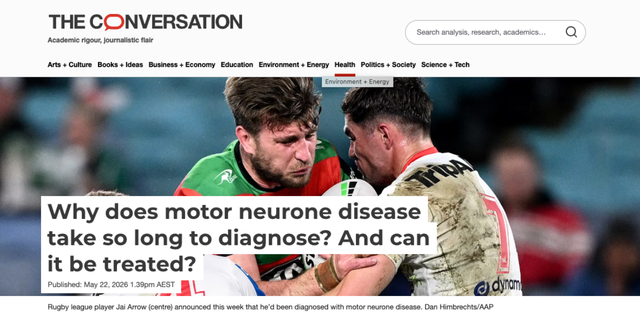
Professors Peter Crack (DBP) and Peter Crouch (DAP) from the School of Biomedical Sciences helped readers understand what’s ahead for rugby league player Jai Arrow, following news of his motor neurone disease diagnosis last week.
Writing for The Conversation website – which shares academic and research expertise with a general audience – they explained that motor neurone disease (MND) is relatively rare. Fewer than 1000 Australians are diagnosed with MND each year. Arrow’s diagnosis has shocked many because the disease is often associated with older adults, not elite athletes in the prime of life.
The disease affects the motor neurones – specialised nerve cells that communicate signals from your brain to muscles throughout your body. It has life-changing symptoms that affect each person differently but worsen over time. The first symptoms can appear suddenly. In Arrow’s case he played the full 2025 NRL season, but recently noticed changes in his speech.
AFL great Neale Daniher, 2025 Australian of the Year, passed away today more than a decade after his diagnosis in 2013 – but most affected people experience paralysis and death within two to five years. Arrow hopes to treat the disease early with medication and take part in clinical trials.
The SBS researchers shared their future focus in the story, including investigating how faulty mitochondria – the energy-producing structures in cells – may contribute to the inflammatory process. Future treatments may target this pathway.
With more research and a focus on early diagnosis, the team hopes to play a pivotal role in turning MND from a fatal disease into a manageable one.