Renowned meiosis researcher Professor Abby Dernburg to deliver 2026 Grimwade Oration
The UC Berkeley professor says the microscopic origins of life still hold fascinating mysteries.
At the very beginning of life, fascinating processes are underway. You might have heard about mitosis – because it is involved in almost all of the body’s cell division needs … except one.
Meiosis takes development from a diploid cell – one with two sets of chromosomes – to haploid cells with a single set of chromosomes. In humans, these cells are sperm and eggs that, once fertilised, form a new genome.
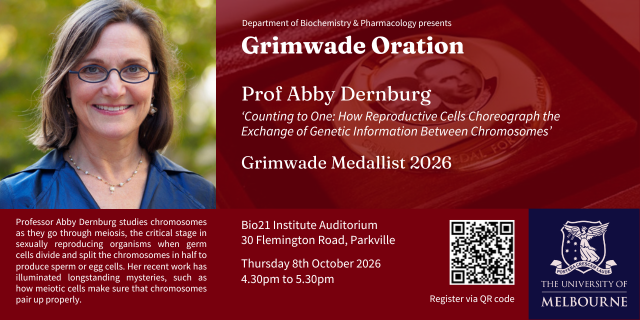
It is this moment of development that Professor Abby Dernburg from UC Berkeley has devoted her research career to. Professor Dernburg will deliver this year’s Grimwade Medal Oration on Thursday 8 October, entitled: Counting to One: How Reproductive Cells Choreograph the Exchange of Genetic Information Between Chromosomes.
The Dernburg Laboratory, in UC Berkeley’s Department of Cell and Molecular Biology, employs genetics, microscopy, genome editing and genome-wide mapping to understand how chromosome segregation happens during meiosis – and how it contributes to genome stability and evolution.
Professor Dernburg’s work has changed understanding of this life-giving process, but she notes that there are still mysteries in her field that remain unanswered. Therein lies the fun.
“I am still very motivated to keep chipping away,” she says. “And I love that I still get to work with curious and creative people who share that passion.”
Growing up, Professor Dernburg was always interested in the microscopic worlds but found early science toys a little frustrating. The first exciting experience she remembers is bringing Lily of the Valley from her yard at home into a high school biology lab to look at under the microscope.
“That was a revelation,” she remembers now. “The cells were so large that they could be clearly seen even with mediocre optics and without fixation or dyes, and the symmetrical arrangement of the cells in the stem and other tissues was so appealing and intriguing.”
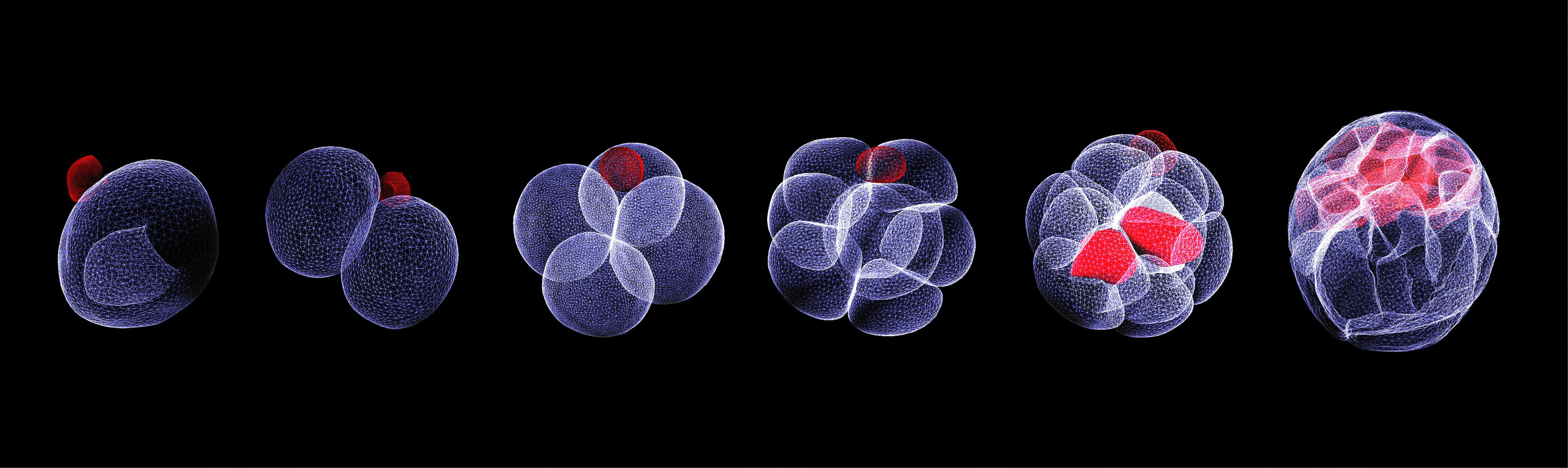
Image: Wellcome Collection/Dr M. Zernicka-Goetz, Gurdon Institute
Some years later, as an undergraduate at UC Berkeley, she worked in Dan Koshland’s lab, which studied bacterial chemotaxis. She later became intrigued by protein structural analysis.
“During the first year of my doctoral program, on a lark, I rotated in the lab of John Sedat, who was developing state-of-the-art fluorescence microscopy. There I fell in love with the images that the lab was recording showing Drosophila embryonic nuclei and chromosomes.”
Using microscopy to study biology, she says, 'encourages me to think deeply about the physical environment in which biological processes occur'.
Work from the Dernburg lab has led to a fundamentally new understanding of crossover regulation during meiosis. She was elected to National Academy of Sciences in 2024 and recently named a fellow of the American Association for the Advancement of Science.
“One thing I find quite humbling and inspiring is that a conceptually similar model for crossover interference was proposed in a 1977 essay by Robin Holliday,” says Professor Dernburg. “He was a brilliant British molecular biologist who married an Australian researcher and moved to CSIRO in Sydney in 1988, towards the end of his research career.”
“His model for crossover regulation did not gain any traction in his lifetime, but after we recognized that crossover patterning is based on protein diffusion within the synaptonemal complex, I rediscovered his essay and was floored that he had anticipated our own insights by roughly four decades.”
Having visited Australia for a Lorne conference in early 2020, with her husband and sons, Professor Dernburg is looking forward to returning, visiting extended family and hopefully exploring a little of Tasmania during her trip. She says she’s honoured to receive the Grimwade medal and to be in the company of those who have received it before her.
“I was also pleased to see that two of them – Randy Schekman and Eva Nogales – are in the same department at Berkeley and people whom I consider to be friends as well as colleagues,” she says. “I am delighted to have the opportunity to return to Australia, in addition to the gratitude and lingering disbelief I still feel about being selected for this honor.”
The Grimwade Medal was established in 2016 and aims to promote the disciplines of biochemistry and molecular biology at the University of Melbourne and more broadly in Australia. Professor Dernburg will be the 10th Grimwade recipient.
The medal is generously funded by the Russell and Mab Grimwade Miegunyah Fund and is awarded to researchers with a distinguished career in research and academia and may have made contributions to commerce and society.
Medallists visit the University of Melbourne and give the Grimwade Medal Oration at the Bio21 Molecular Science and Biotechnology Institute, and attend a gala dinner in their honour and participate in a number of networking and mentoring activities.
Event Details
2026 Grimwade Oration Counting to One: How Reproductive Cells Choreograph the Exchange of Genetic Information Between Chromosomes 4:30 PM - 5:30 PM Bio21 Institute | Register for Grimwade Oration via Eventbrite |
2026 Grimwade Exclusive Q&A Bio21 Institute | Register for Grimwade Exclusive Q&A via Eventbrite |