MRFF Funding offering a lifeline to sufferers of paediatric gut motility disorders
Congratulations Dr Lincon Stamp and Dr Marlene Hao, Dept of Anatomy & Physiology, awarded $6.5M in funding from the Australian Government’s Medical Research Future Fund to combat paediatric gut motility disorders.
Hirschsprung disease (HSCR), paediatric achalsia and gastroparensis, are a collective of rare but extremely debilitating gut motility disorders affecting infants and children. Sufferers endure a lifetime of often life threatening symptoms which are currently inadequately managed, affecting their day to day lives severely, requiring repeat hospitalisations, surgery and ongoing care.
Each disorder is rare, with prevalence ranging from 1 - 20 in 100,000 births, collectively they represent a substantial group. Unlike diseases such as Parkinson’s or Alzheimer’s which are onset in adulthood, these disorders affect our youngest and most vulnerable, and for the remainder of their life.
Bringing the world’s best together
The project, led by University of Melbourne, brings together a world class team of researchers and clinicians, as well as industry and patient advocacy partners, to accelerate the development of a stem cell therapy treatment.
Paediatric gut motility disorders are frequently caused by defects to the gut’s intrinsic neural network, the enteric nervous system (ENS), often called the second brain. The ENS plays essential roles in controlling propulsive motility patterns and other key gut functions. Any impairment, disturbance, or absence of the ENS can have life-threatening consequences.
The research project, encompassing a large international team of collaborators, will examine the potential of replacing the lost or damaged gut nerves using stem cells, with the hope of restoring normal gut health in infants affected by gut disease.
Dr Stamp says new treatments for digestive diseases involving gut nerve damage or loss are urgently needed.
"Digestive diseases affect individuals throughout life, and those affecting infants often impact their health and quality of life from birth. Current treatments leave a lot to be desired, often only treating the symptoms rather than the underlying cause."

Photo: Dr Lincon Stamp and Dr Marlene Hao (centre) with their Laboratory Team
We believe that our novel approach of restoring the gut nerves using stem cell therapy will transform the treatment of these diseases
Dr Lincon Stamp and Dr Marlene Hao
The research grant funding is part of the Medical Research Future Fund Stem Cell Therapies Mission scheme and will run for 5 years. The investigations will define a direct pathway to market and clinical trials, to characterise and test the efficacy of the stem cell therapy in the preclinical setting, giving confidence to move to production of a clinical grade cell product and eventual first in human studies.
"Working together with our clinical collaborators at the Royal Children’s Hospital, Queensland Children’s Medical Research Institute and the University of Newcastle, and with the support and guidance of industry partners at BlueRock Therapeutics, Pluristyx, Alimetry, Cell Therapies and CCRM-Australia, we hope to advance this research from the bench to the bedside," said Dr Marlene Hao.
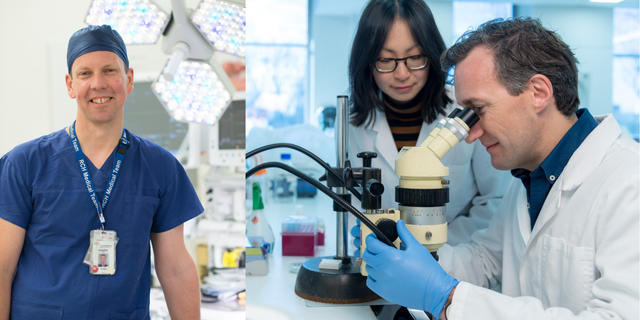
Photos (L-R): Prof Sebastian King, Dr Marlene Hao, Dr Lincon Stamp
"The medical and surgical options for these rare conditions have largely remained the same for the last 30 years, while our understanding of the potential for stem cell therapies has expanded exponentially" said paediatric surgeon and collaborator Professor Sebastian King from the Royal Children’s Hospital. "Our collaborative efforts, taking advantage of so many talented and dedicated researchers and clinicians, have the potential to change the way we treat some of these conditions forever."
The investment in research offers hope to families such as the Lloyd-Morgans, who have an appreciation of life both with and without these cruel and debilitating disorders – as nine year old twin Lilly suffers with achalasia, struggling daily while her sister and family provide support. The Lloyd-Morgans travelled to the United States of America for corrective surgery when Lilly was just six years old, but despite improvements, life is still challenging.
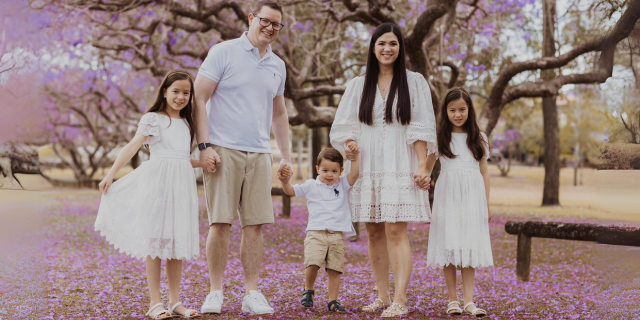
Photo: Llyod Morgan family and Lilly (far right)
“Lilly struggles with achalasia everyday and there is significant concern about the degenerative condition’s impact on Lilly’s long term quality of life as it progresses" says Lilly’s parents Rhys and Marianne Lloyd-Morgan. "The stem cell therapies being developed in this project are incredibly exciting and offer hope for Lilly, our family and others impacted by achalasia and other motility disorders.”
Learn more about Lilly's story 'A glimmer of hope for patients who can't swallow', National Stem Cell Foundation of Australia.
This University of Melbourne led project is in partnership with the Memorial Sloan Kettering Cancer Center (USA), Royal Children’s Hospital/Murdoch Children's Research Institute, Monash University, Florey Institute, Flinders University, University of Newcastle, Queensland Children's Medical Research Institute, Mount Sinai Hospital (Canada), Auckland Bioengineering Institute, and patient advocacy partners at Help4HD, REACH HD and the Lloyd-Morgan family.
Grant Information

Treating tiny tummies: next generation cell therapies for paediatric gut disorders
Gut disorders in children, particularly those affecting the gut nerves, can be not just disruptive and uncomfortable, but life-threatening. Current treatments do not cure the disease or provide longterm relief from symptoms. New treatments for childhood gut disorders are urgently needed. We aim to accelerate the development of a safe and effective stem cell-based therapy to restore gut function in these vulnerable patients.
Learn more
University of Melbourne, NewsRoom, 23 September 2024, 'Researchers awarded $36m funding from MRFF for projects across health and science.'
Australian Government Department of Health and Aged Care, 10 September 2024, '$55 million for stem cell therapies, data infrastructure and research into rheumatoid arthritis.'
School of Biomedical Sciences, 18 June 2024, 'Cure Cancer profiles the work and lab of young guns Dr Marlene Hao and Dr Lincon Stamp'
Stamp & Hao Laboratory: Plasticity of the enteric nervous system
Find an Expert Profile Dr Lincon Stamp
Find an Expert Profile Dr Marlene Hao