Grimwade Medal Oration 2025
Prof Markus Covert set to present a comprehensive exploration of cell behaviour through a computational and experimental lens at the Grimwade Oration in November.
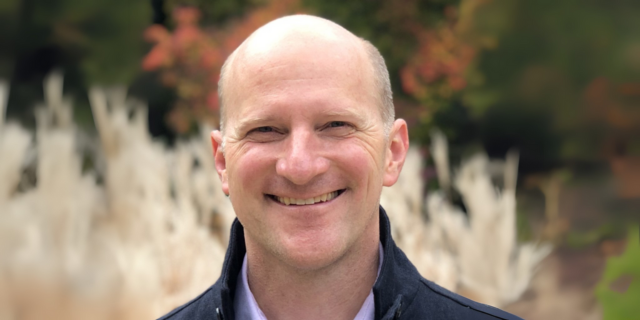
Image: Prof Markus Covert
In a world increasingly shaped by data and discovery, the effort to build comprehensive computer models of living cells is an exciting one.
This year’s Grimwade Medal Oration will be delivered by Prof Markus Covert, researcher, Ram Shriram Chair and Professor of Bioengineering at Stanford University. Over the course of his career, his lab has generated several new exciting technologies to measure, analyze, and mathematically model the behaviors of individual cells. The lab is probably best known for constructing the first "whole-cell" computational model, which explicitly represents all known gene functions and molecules in a bacterial cell - an advance which was highlighted by the journal Cell as a highlight publication of the 40-year history of that journal.
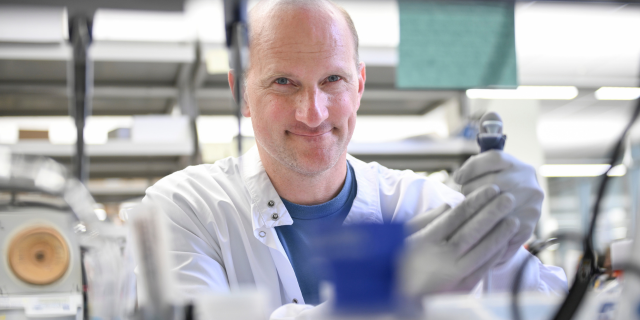
Image: Prof Markus Covert in the lab
His talk entitled, 'The E. coli Whole-Cell Modeling Project: Accelerating Discovery via Comprehensive Biological Simulation' will explore groundbreaking research from his lab and their efforts to create the first computer models of cells that take all of the gene content and known function into account and can predict cell behaviour.
Francis Crick first called for a coordinated worldwide scientific effort to determine a “complete solution” of the bacterium Escherichia coli. Markus's Lab has been working for some years now to complete a model of E. coli that takes into account all of the known functions of every well-annotated gene, in order to better understand and predict the behavior of this scientifically-relevant and industrially-significant model organism. Now that a majority of the annotated gene functions have been added to the model, the lab's simulations have generated biological insights that change perspectives about cellular biology and physiology. As examples, Markus will present his new findings regarding how metals are utilized in E. coli, as well as the effect of gene organization into operons, and the impact of engineering new gene content into the chromosome.
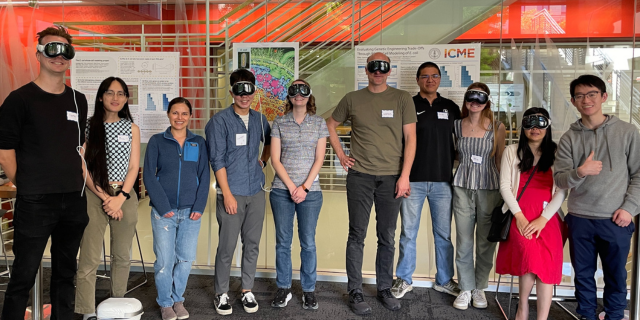
Image: Markus Covert with his lab group demonstrating whole-cell simulations on the Vision Pro
This has been called ‘the Holy Grail of systems biology’ and ‘a grand challenge of the 21st century’ - it's the driving research passion of my career.
As Markus describes in his personal essay published in Scientific American, his fascination in systems biology was shaped by curiosity, good mentors and key moments. He says it all started with the question: "Was there some way to simulate life - including all the marvellous, mysterious and maddeningly complex biochemistry that makes it work - in software?"
His curiosity led to an 'a-ha' moment where he built a computer model of a simple, single-celled organism - the bacterium Mycoplasma genitalium - that simulated nearly all its known cellular processes.
Now, Markus is excited to see the model predictions in his field that are leading to breakthrough discoveries.
I believe we are on the verge of discovering entirely new and exciting biology.
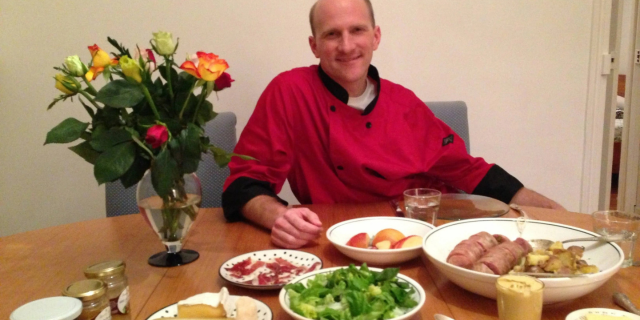
Image: Markus Covert at his Science of Cooking Class (in Paris)
Besides his research, Markus says it’s been a thrill to teach what has become an incredibly popular “lecture, lab and lunch” course: Bon Appétit, Marie Curie! The Science of Haute Cuisine.
Thanks to the Bing Overseas Studies Program at Stanford, I have even been able to offer this course in Paris twice – a highlight of my teaching career.
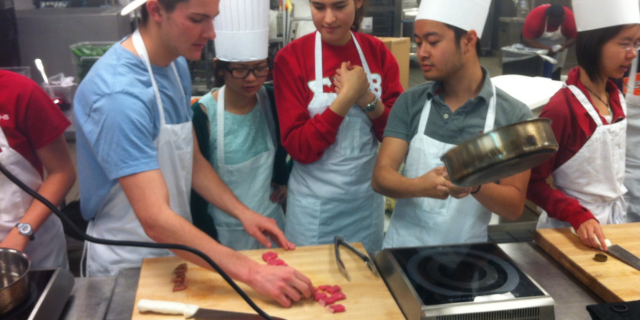
Image: Students at Markus Covert's Science of Cooking Class
Markus is also the author of the textbook Fundamentals of Systems Biology: from Synthetic Circuits to Whole-Cell Models. He has received several awards for his efforts to develop new technologies, in particular the NIH Director's Pioneer Award, and the Paul G. Allen Family Foundation Distinguished Investigator and Discovery Center awards. He has also consulted in industry, including on the scientific advisory board of Emerald Cloud Labs, and as an inaugural Ambassador at X Labs, previously known as Google [X].
His advice for early- to mid-career researchers facing setbacks, is offered in a soccer analogy.
Science is a lot like soccer - the big successes can feel few and far between but you really can make progress every day. And when a breakthrough finally does land, don't forget to celebrate…we don't shout GOOOOOOOOOOOOOOOOOAAALLLLLLL every time we make a new discovery, but maybe we should!

While Europe has been a frequent destination for conferences and collaborations, Markus says he is especially excited about his first visit to Australia.
We look forward to welcoming Markus. Please be sure to register for the Grimwarde Medal Oration via Eventbrite.

2025 Grimwade Medal Oration – Prof Markus Covert
Date: Thursday 27 November 2025 from 4.00 pm to 5.00 pm
Location: Bio21 Institute Auditorium, 30 Flemington Road, Parkville
Registration: via Eventbrite