Australian Pathogen Genomics Program

The Australian Pathogen Genomics Program (AusPathoGen) is Australia's flagship national pathogen genomics translational research program, funded by the Medical Research Future Fund.
Since 2021, AusPathoGen has developed and delivered research projects to inform implementation of national genomic surveillance. Through these projects, AusPathoGen has a network of 250 stakeholders and 45 organisational partners across all states and territories, which has produced the largest pathogen genomic dataset (~300,000 pathogen genomes) available in Australia, providing opportunity for national health insights that were previously not possible in a federated system.
AusPathoGen’s research to date has demonstrated the transformational value of pathogen genomics in detecting real time outbreaks, and established the foundational infrastructure, tools and partnerships for national genomic surveillance.
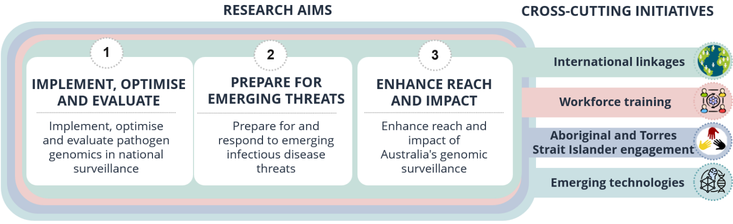
AusPathoGen continues to build on these initial findings to implement nationally integrated public health pathogen genomics surveillance, investigate the application of genomics to respond to emerging infectious disease threats, and enhance the reach and impact of pathogen genomics in Australia.
From 2026-2029 AusPathoGen will continue to deliver a broad set of outcomes including; Reduced infectious diseases; Preparedness for emerging threats; One Health genomics models; Genomics-literate workforce; Evidence of impact; Global leadership
For more information visit AusPathoGen
Contributors








Cross cutting themes
AusPathoGen’s cross-cutting initiatives promote and apply best practice research methods across AusPathogen projects, and support development of new partnerships or initiatives that will expand the reach and impact of AusPathoGen’s outputs, or contribute to sustainability of outcomes.
Emerging technologies
AusPathoGen’s Emerging Technologies cross-cutting theme aims to identify and test advanced analytical methods for understanding the emergence, spread, and evolution of pathogens to enhance impact of genomic and epidemiological data on infectious diseases control, will provide the structure to enable this work.
The theme is led by Professor Torsten Seeman, Lead Bioinformatician at the Centre for Pathogen Genomics, University of Melbourne in collaboration with A/Prof Freya Shearer, Australia-Aotearoa Consortium for Epidemic Forecasting and Analytics, University of Melbourne and Professor Matthew McKay, University of Melbourne.
Emerging technologies will test cutting-edge modelling, data analytics, phylodynamics, artificial intelligence and bioinformatics approaches to optimise and contribute to efficient approaches to genomic surveillance in Australia.
Workforce capacity building and training
AusPathoGen’s Workforce capacity building and training cross-cutting theme will support formal training pathways (PhD students, genomics curricula in University training) and partner with other major national genomic programs to enhance collaborative training and generate a genomics-literate workforce across Australia.
The theme is led by Professor Nicola Stephens, University of Tasmania and aims to address the current training gap in pathogen genomics through workshops and short courses for consumers of genomic data (e.g. health departments, surveillance units).
Aboriginal and Torres Strait Islander Engagement
AusPathoGen’s Aboriginal and Torres Strait Islander Engagement cross-cutting theme aims to ensure that all AusPathoGen activities appropriately incorporate Aboriginal and Torres Strait Islander health priorities and perspectives to inform nationally integrated public health pathogen genomics surveillance.
Led by Mr Mark Mayo, Menzies School of Health Research, the theme will undertake facilitated consultations communities, service providers (i.e. Aboriginal and Torres Strait Islander medical providers) and leading bodies to define appropriate approaches and methods for including Aboriginal and Torres Strait Islander health priorities, and support information sharing of outputs.
International linkages
AusPathoGen’s International linkages cross-cutting theme uses publicly available data to contextualise Australian datasets to further enhance robust data analyses. This theme is also disseminating learnings internationally to enhance reach and impact and Australia’s leadership in this area.
The theme is led by Professor Ben Howden and leverages international partnerships with academic institutions globally and multilateral agencies (i.e. World Health Organisation) to advance the agenda of supporting implementation of pathogen genomic surveillance through translational research.